Tuesday, 14 March 2017

Td5 D2 engine - Turbo Wastegate (1)


The turbocharger on a Td5 engine is a Garrett design that comes complete with a Wastegate Actuator mounted onto the turbo body. The wastegate actuator is highlighted in red below...

The adjustable control rod extends under boost pressure to move a pivoting shaft that opens a small valve internally in the exhaust side of the turbo.

The above photo shows a generic Wastegate Valve fitted inside a turbo-charger. The control rod can be seen attached to the outside of the valve stem. The wastegate valve opens internally into the exhaust side of the turbo body and allows the exhaust stream to by-pass or 'bleed' away from the spinning turbine thus reducing the generated 'boost' pressure in the inlet manifold.

The function of the wastegate-valve is crucial to stop the turbo over-boosting the engine and things quickly going BOOM.


OPERATION AND INSTALLATION
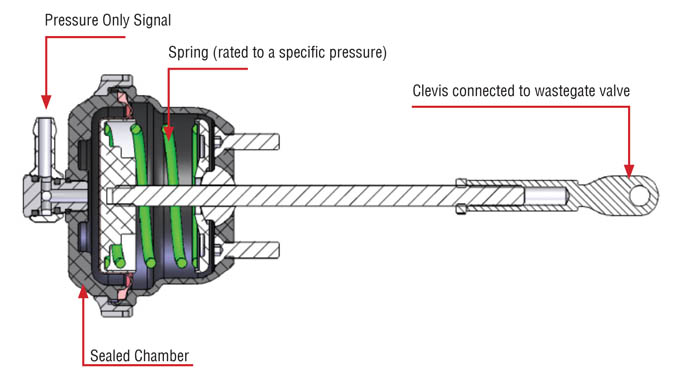

The body of the Wastegate Actuator is bolted to the body of the turbocharger and it contains a strong spring and diaphragm that normally hold the wastegate valve in a closed position. 

When sufficient air pressure is applied to the actuator, the spring will compress and extend the control rod which in turn opens the wastegate valve. The pressure is supplied via a small-bore hose connected to the Intercooler intake. The available pressure is itself generated by the spinning turbine.

There is not much in Rave about the operation or installation of the Wastegate on the Td5 Discovery other then it's connection to the 'Wastegate Modulator'. (see below).  


PROBLEMS WITH THE WASTEGATE.

The turbocharger produces maximum boost at around 3000rpm. If the engine is driven gently and economically it will seldom get to 3K rpm!!.  Long periods of non use won't help either. If the wastegate mechanism is seldom operated, the physical valve inside the turbo can seize due to the intense heat and the deposits from the exhaust stream,

I tried to move the wastegate operating arm manually using a wrench clamped onto the shaft. Nothing would move either back or forth. I had watched some YouTube vids to get an idea of what to expect, but the lack of any movement was a worry and I had to investigate more. 

It's also possible that the Wastegate Actuator can develop an internal leak from a worn or punctured internal diaphragm.


REMOVING THE WASTEGATE ACTUATOR.

The two 10mm nuts holding the actuator body to the turbo body are easily accessible. The clevis-pin connecting the arm to the wastegate valve is nicely hidden under the heat shield. It is possible to spray the valve shaft housing with lube to help free it up, but better access will be gained by removing the heat shield.

There are three bolts that hold the heat shield onto the exhaust manifold. Two have easy access, but the third one is hidden and fiddly to get at. It is screwed into the hottest part of the exhaust manifold and will almost certainly be seized and ready to snap off. 

As expected, the third bolt was very tight and I was weary of shearing the head. That would allow the heat shield to just rattle away and it could even fall down onto the turbo body. I decided to drill out the rivets holding the heat-shield upper panels together and to bend the upper panel to allow access to the control rod. It was easy enough to re-secure the panels with two small nuts and bolts.

Once removed it was much easier to physically move the rod against the pressure of the internal spring. 


I am assuming that the fitted actuator has the same 'spec' for all Td5 engines? I find myself wondering what the internal springs natural tension is as opposed to the 'applied' tension from the control rod adjustment?  I'm thinking that springs of differing 'strengths' will react faster/slower to the same applied pressure?... That would in turn effect the reaction time and the physical movement on the wastegate valve spindle..   Hmm, more research needed!!


WASTEGATE SPINDLE.

Attention then turned to the wastegate valve operating spindle mounted on the turbo body. 

Here is a photo from the Web that shows a typical Wastegate Valve mounted onto the exhaust side of the Turbocharger...


The spigot above the thumb is where the Actuator control rod attaches.

Liberal spraying of WD and some pliers soon had the lever shaft moving freely. I found that it will only move back and forth about 1/3 of a turn..

I read somewhere that lubricating the shaft is not recommended due to the harsh operating temperatures and the risk of the lube gumming-up in there.  


The linear movement of the control rod is limited by 
the spring compression in the actuator body. It seems all the 'action' takes place via this controlled little movement. At rest, the control rod must hold the spindle closed, otherwise the pressure building exhaust stream will be bled away from the turbine via the open valve which can only decrease the available generated boost.


BENCH TESTING THE ACTUATOR.


The control rod is fitted with a lock-nut and a black knurled rotary adjuster to alter its length and adjust the available boost. This is a factory set adjustment and there is no mention in Rave about altering it in service. 

Altering the length of the control rod has a direct effect on the available boost pressure. Turning the adjuster just one turn can bring benefits or indeed downfalls!!. Caution is advised, but it is now a possibility.

Manually extending the control rod against the pull of the spring is physically demanding and I got to wonder just how much pressure is needed to operate it? Even at this stage I was unsure whether the unit was vacuum or pressure fed. 


I placed a bicycle stirrup pump onto the hose connection and used some blue tape as a visual marker. The pump is fitted with a wide reading gauge but it's accuracy is untested.

   
      ...this is at rest or zero psi...

..and this is maximum extension at 20 psi.

The control rod started to lift around 10psi and extended smoothly. I kept the pressure on for a while to check the unit was airtight.

When fitting the Actuator back onto the turbo, I used the pump to easily align the control rod end with the wastegate valve shaft, making easy work attaching that fiddly clevis-pin.


So I am now confident that the Wastegate Actuator and the valve in the turbo are working together as they should. I still need to check the solenoid modulator and it's pipework.


ADJUSTING THE BOOST. 


Just for the record, when I dismantled the adjuster I was careful to record the locknut position by carefully counting the screw threads visible.


I made the above notes after reading that even half a turn can make a difference. I went ahead and shortened the rod to show 12 threads before re-mounting it on the turbo body. In theory it should increase the boost. 

I now have to connect the Nanocom and study the boost readings closely to assess the situation..... (Update...This 'situation' is still ongoing and is detailed more in other blogs).


THE WASTEGATE MODULATOR.

Tracing the path of the small-bore rubber hose attached to the Wastegate Actuator will lead to the Wastegate Modulator. The body of the modulator is bolted to the side of the engine block.


Td5 Defenders are not fitted with the modulator and their Wastegate Actuator is plumbed directly into the Turbo outlet via the small-bore hose. Both versions use the generated boost pressure to open the Wastegate Valve once the boost pressure builds and overcomes the resistance of the Actuator spring.

A Td5 Discovery engine will get 'on boost' quicker and for longer then a Td5 Defender. Eliminating 'wastegate creep' is one reason for fitting the solenoid controlled valve onto the engine. There is a performance gain to be had this way.

See also: Td5 D2 engine - Wastegate Modulator 


Td5 D2 engine - MAF Sensor (3)

The new MAF sensor arrived today from JGS4X4. I have bought from them before and when you consider that I ordered it on Friday and it arrived the following Monday morning, that's a good service..

There is a lot of discussion out there about only buying the official LR OEM sensor. All the others are deemed to be cheap nasty copies that give 'false readings' in use. It's difficult to qualify statements like that without testing a whole range of these sensors. It's easier to accept that expense equals quality.

A new 'Siemens' branded unit is north of £80. Other unbranded or 'aftermarket' units can be had from £15 upwards. There is even a busy second-hand market in these things, - plenty of ways to be landed with a turkey!

So it comes down to cash flow. Even the parts suppliers must consider this when deciding which manufacturer/distributor to get their stock from. I also like to think reputable suppliers will have one eye on their own reputation for selling quality parts...

When looking around for the replacement sensor, I priced the local independent LR garage who stocked Britpart for £35 .  JGS4X4 where cheaper by £8 , but didn't state what 'make' it was. (listed as unbranded). I took the gamble figuring I could then buy a new stock air filter with the difference.

That whole 'Britpart' question turned up again. I got to thinking that as they seem to offer a 2 - year guarantee on everything these days (no doubt because of the bad rep) they should be back up there. So I was kind of wanting the new MAF to be a Britpart..

This is what I ended up with. A cheap and cheerful pattern copy. At least the 'stock' date is recent. There is no branding or any markings at all on the sensor body except for the airflow direction arrows. 

Studying the unit closely gave me the impression that it was maybe even a refurbished unit. There were more clues as to the way the sensor unit is mounted in the tubular body. Excess bits of a black rubbery mastic type glue were to be seen.

But by far the biggest difference was with the sensor wires. I was expecting the same arrangement with two fragile wires but instead this sensor has two resistors soldered in place. 

It is possible to read off the colour bands on the larger resistor. I have no idea how this set up will compare to the original one. I can only hope it gives 'correct ' readings..

Another image of the new sensor. Of interest here is the small hole visible on the mirrored base-plate of the sensor. Whats that about I wonder? Also, that mirrored surface is not as smooth as the original and has what looks like fingerprints on its surface!!

So, all things considered, I tried the resistance tests across the pin out terminals..

NEW MAF RESISTANCES 

PIN 1-2  =  194K OHM
PIN 1-3  =  1670M OHM
PIN 2-3  =  1960M OHM

At least I got a reading even though they are nothing like I was expecting. Think I'm in un-chartered territory here..

15/03/17 - Went ahead today and fitted the new MAF filter to Hx. Went out on a test run. Right from the start it was possible to feel that the engine was more lively and willing. 

Took the Nanocom along and plugged in to the OBD. At idle, the 'instruments' diagnostic gave the following..

IDLE  SPEED  -  744RPM
COOLANT  -  59.5°C
TURBO PRESSURE  -  0.04
AMBI PRESSURE  -  102.37

AIR FLOW  -  64.5 G/HR

AIR INLET TEMP  -  25.3°C
FUEL TEMP  -  53°C

The new MAF filter now measures the correct airflow value at idle. It should be in the range of 55 - 65 g/hr. Glad to see its right up there.!

Air flow at 2k rpm is now 343g/hr. The old filter was showing 200g/hr.

I continued to drive around with the Nanocom connected, but I gave up looking at the numbers in favour of enjoying the drive! 

The Nanocom offers the facility of recording data to a SD card so that it can be studied later rather then driving with one eye on it trying to remember the values!!  - a lot safer.

So, to conclude, replacing the original MAF sensor with a cheap and cheerful copy has brought the engine back alive. 

Let's see how long that lasts.


Monday, 13 March 2017

Td5 D2 engine - MAF Sensor (2)

With a new MAF on its way, I decided to delve more into the construction and workings of the MAF sensor using the removed example.

I started to think about removing the actual sensor from the MAF body. This will no doubt end in the destruction of the unit but I am so curious as to how it is assembled. Just as curious to discover the meaning of the mirrored surface on the sensor base.

Read that in operation, one of the wires can get heated to +200°C above the ambient temp, so there is probably some strong insulation going on here... The sensor wires are supplied with 12v so in theory I guess (without seeing inside) the wire itself gets 12v and therefore is going to have to be pretty thin to achieve the resistance value to get to 200°C. Add together all the duty cycles running hot and cold, the thermal expansion pressure and the engine/suspension vibration... Tough time in a harsh environment.  Respect the MAF  !!

Attention turned to the two wire elements. The resistance readings I obtained would suggest that their circuit was broken. I probed the mountings of each wire for continuity and there was none. Perhaps these wires were already snapped.?

The wires are very fragile and their delicate mounting seem flimsy. I guess this is to do with their resistance properties. I'm beginning to see why they are so expensive. The manufacturing tolerances must be high and that in turn raises the quality control, the expected lifespan and the end cost.

All of the blogs that talk of cleaning the MAF clearly state how delicate the two sensor wires are and to avoid any contact with them. In theory, any 'dirt' particles can only come downstream from the air filter carried on the air stream and to settle on the tiny heated wires is a big ask. I guess the big concern would be residues burnt onto the surface of the wires altering the thermal cooling of the wires and thereby leading to 'altered ' readings.

I started to think that the wires themselves through their heating action are probably self cleaning and should be left alone if there is no visible debris on them.

The cleaning method is to use aerosol contact cleaner, carb cleaner or even WD40.  Even the force of the spray can sometimes break the wire. Evaporating cleaners work best. They need to dissolve any dirt then wash it away and evaporate. I decided to use Meths and some electrical switch cleaner. .

Initially I thought of making a 'bath' of meths that I could sink the whole sensor into (at least up to the wires), but on reflection abandoned that idea. The only visible dirt I could see was on the end guards and caught on the fine wire mesh behind the 'leading' guard. Photos were taken before the cleaning began..


I resorted to pricking out the dirt from the wire mesh using a thin wire poked through to dislodge it. The internal surfaces of the sensor were wiped down with a cotton bud soaked in meths. There was not much dirt in there at all. I wiped the sensor mount carefully and avoided the actual wires. There was a little yellow spot on the sensor mount body that dissolved away with the meths.. I assumed it to be some kind of manufactured colour code?

At this point I had a clean but none functioning sensor. Attention now turned to the wires themselves.
It was impossible to see any breaks in the wires so I decided to physically touch them with a probe and sure enough the first wire tested flexed away from one of its mounts confirming a break and the lack of continuity and the infinite resistance. The second wire, well see below...


This wire just disintegrated before I could visually see any separation from the terminals. Luckily I had placed a piece of plain white paper inside the sensor to act as a non-distracting background. The paper caught the wire fragments and revealed the golden colour of the 'wire'.  This made me wonder if the wires are actually gold, considering the electrical non-tarnishing qualities of the metal. ?

Alas, not gold! I mean if studied real close it is possible to see that the 'gold' colouring is indeed some kind of non-conducting coating on the surface of an exceptionally fine wire. 

Research on Rave and on the net speak of a 'film coated wire' at the heart of the sensor. 

I then set out to get continuity between the wire mounts by using bare wire and test leads...

I was quickly able to confirm continuity between all the sensor-wire 'poles', but I could not get any continuity to any of the 3 pins on the connector. I was getting ready to break-in to the sensor body when the postman brought me this. ...


.. the new MAF sensor. 

Thursday, 9 March 2017

Td5 D2 engine - MAF Sensor (1)

Recently become aware that the performance of the engine has declined somewhat more then expected.

Daily usage of Hx has drastically declined over the past few years and it never gets a 'good run' anymore. It used to do about 40 mile each day commuting on a good mix of single and dual carriageway. Now it can sit stationary for nearly a week and then only do a short 10 mile trip. This usage cannot be good for its general well being and it's caused me to suspect the fall in performance.

I recently connected the Nanocom to Hx and read off the engine inputs. As always there is a lot of info to digest, but I reckon a methodical approach to interrogating the various engine management sensors can only be beneficial both to me and Hx.

So, where to start? 
  
After a good read of Rave and a trawl through the online blogs attention turned to the 'Mass Air Flow' sensor commonly termed  ' MAF '

This sensor sits downstream of the air filter and upstream of the turbocharger. It provides a measurement of the airflow into the turbocharger that the ECU can interpret.

Accurate measurement of the airflow is very important to the engine running profile.

Should this sensor fail or go 'out of range' the ECU has a fail safe setting it will use to maintain the engine operation. This fail safe setting is perfectly driveable but will not deliver optimum performance.


The sensor is connected to the wiring loom via a three-pin connector ( CO149 ).

PIN 3  -  12v input from engine fuse box.

PIN 2  -  Variable output (0-5v) to ECU.

PIN 1  -  Earth path via ECU

Back probing the connector can easily confirm this. Rave gives the loom connections to test for continuity in the cabling..

Online blogs would suggest that a reading of 5v from Pin 2 equates to 60 mg/hr. which is the lower end of the range with the engine at idle.

There is another basic resistance test that can be done with the sensor unplugged...

MAF Sensor Resistances.
(Got these figures from the Web)

GOOD MAF
Pins 1-2  -  16.8 K/ohm
Pins 1-3  -  34 M/ohm
Pins 2-3  -  34 M/ohm

BAD MAF
Pins 1-2  -  16.8 K/ohm 
Pins 1-3  -  6 - 20 M/ohm
Pins 2-3  -  6 - 20  M/ohm

These 'Bad' figures are still functional and within range. The figures can get further away from the ideal before the ECU will 'ignore' the MAF sensor and select its default values.

By far the best way of testing the sensor performance is to do it 'live' via the OBD socket. I have a Nanocom diagnostic reader and have already noted the values with the engine running and it was this that convinced me the sensor was 'out of range'.

The Nanocom is able to read the airflow figures direct as Kg/hr values. More on this later.....

Markings on the removed MAF body identify it as a SIEMENS unit. The LR part number is MHK100620. I believe this to be the original factory-fitted unit now with nearly 15 years of service.

Replacements are readily available. MAF sensors are used by almost every fuel injected vehicle and this tubular housed design is very common across many manufacturers.

There is a great debate about the varying sources and prices of replacements. Siemens or VDO get top billing and can cost upward of £100 plus. Much cheaper unbranded units can be sourced for £20 - 40. Reliability is a big concern, and the full range of readings is crucial. I guess you pay the money and take the choice...

After years of service there is the inevitable build up of dirt and deposits on the wires which can effect the readings. Often with some VERY careful cleaning, the performance of the sensor can be restored again, but I reckon the best way is to replace the unit.

So just what is the money buying and how does it work...?


Inside the unit can be seen two thin fragile supported wires that are heated and then cooled by the airflow. The changes in ambient temp are quantified by electrical resistance and outputted as a variable voltage..

Or, as Rave  puts it...

".....The MAF sensor works on the hot film principal. The MAF sensor has two sensing elements contained within a film. One element is controlled at ambient temperature e.g. 25°C while the other is heated to 200°C above this temperature e.g 225°C.  As air passes through the MAF sensor the hot film will be cooled. The current required to keep the constant 200°C difference provides a precise although non-linear signal of the air drawn into the engine. The MAF sensor sends a voltage between 0 and 5 volts to the ECU proportional to the mass of the incoming air. This calculation allows the ECU to set the ratio for varying operating conditions...."


And dirty it is. This is a wet wipe that was just pressed into the air filter side of the sensor body. The dirt appeared to be more oily then dusty..... The heated wires inside would probably bake any dust particles onto their surfaces.


The trailing or turbo side of the body was a lot cleaner. It is possible to remove the circular guard to get better access to the inside of the sensor body.

Looking through towards the front of the sensor. If enlarged its possible to see small particles caught in the fine wire mesh grill that sits behind the front plastic grill.

Three photos attempting to show the actual sensor wires in close up. They looked pretty clean to me. In the last photo the curious mirrored surface of the sensor 'arm' base-plate can be seen. I have no idea of its function in there !

Must mention there was a small yellow painted dot on the base of the sensor body inside the unit. It came off with the meths I used to clean up in there. Also, there are small circular indentations on the side surfaces below the wire elements, but I can't be sure if they are drillings or not. 

I got frustrated that the sensor unit itself seems bonded to the casing and is not de-mountable. Since I have purchased a new MAF sensor, I might just break the original down to satisfy my curiosity....


TEST READINGS FROM FITTED MAF.

Target values are the following
55 - 65 kg/hr at idle
500  -  650 kg/hr at load  (3k rpm)

NANOCOM LIVE READINGS 

46 kg/hr at idle  (745rpm)
200 kg/hr no load ( 2k rpm)
250 kg/hr loaded  (2.5k rpm)

note: It was not easy to get the revs up beyond 2.5K which was a concern in itself.

Clearly something is amiss and getting the above results was reason enough to remove the MAF from Hx.

MULTIMETER RESISTANCE TEST.

Target readings accross the 3 pins.
PINS 1-2  = 16.8 K/OHM
PINS 1-3  =  34 M/OHM
PINS 2-3  =  34 M/OHM

THE HX ROGUE MAF

PINS 1-2  =  16.6 K/OHM
PINS 1-3  =  NO reading (infinite)
PINS 2-3  =  NO reading (infinite)

Like I said, there's a new MAF on its way !!!


Wednesday, 22 February 2017

Td5 D2 engine - FPR Fuel Pressure Regulator

The recent episode with the leaking Diesel had me immediately suspecting that the (FPR) Fuel Pressure Regulator mounted on the lower rear cylinder head had failed again..

It was replaced 4 years ago and with it being a 'Britpart' item, I have always expected it to give up the ghost!  Britpart seem to have a bit of a reputation within the LR community for unreliable parts. Regretfully, I can only add to that from personal experience and I always wince when I buy something blind online and it arrives in the dreaded 'blue-box'!!

With that in mind and to give me some early warning of imminent future failure, I fitted it with a length of blue vacuum-tube (sourced from the EGR removal) connected to the 'leak-off' tube and routed down below the chassis to drain onto the ground behind the front wheel. 

Removing the unit from the vehicle is quite an undertaking in itself and it is well covered in the online blogs. Here is the useful instruction sheet provided with the replacement unit.


Thumbs up to Britpart here, they even include a very handy 'elastic-band' tip for holding and positioning the bolts and gasket during the re-assembly. It's the kind of tip that can be utilised on any other awkward or restricted install.

To that end, I would offer the use of a small inspection mirror to get eyes on the situation and particularly on the location of the lower bolt. (Which is right next to a manifold nut and easily confused 'blind'). Furthermore, if the front wheel is removed, better access to the lower bolt can be had by looking through the gap between the inner arch and the chassis rail from within the wheel arch. Direct line of sight to the bolt head is possible and the combined reach of two or three lengthy socket extension bars makes the job a lot easier.

Once it is all re-connected, the fuel system will need purging of air before trying to start the engine.. It is a fairly straightforward operation and loaded with satisfaction...

DO NOT THROW THE OLD UNIT AWAY!!

Having the old original unit lying around 'spare' gave me the opportunity to refurbish it with new o-rings and a new regulator rather then forking out again for a complete unit. I like the idea of having a spare unit handy just in case the mounted one fails.... 


Here is the removed Fuel Pressure Regulator complete with its thin metal plate gasket. There are two versions of the FPR based on whether the Td5 engine is an early 'two-pipe' or later 15P 'three-pipe' model. Hx is a three-pipe 15P engine. There are also slight pattern design differences between the gaskets.


The 'fit' of the gasket seen above looks a bit odd against the machined face of the FPR body. Despite it being metal, it is definitely not re-usable as it's design allows segments of its surface to be crushed flat to achieve the effective seal. 

The gasket is readily available separately but it's better to buy it as part of the re-furb kit many independents offer on E-bay. That way you also get the required pipe-sealing o-rings and maybe even a new regulator unit as well.


The crushable sealing lines can clearly be seen on the triangular metal gasket plates above. This photo also shows the slight difference in the pattern. The 15P Td5 gasket is on the left.

The above re-furb kit even includes two o-rings to fit the actual pressure regulator. They are not available from LR and this E-bay seller has sourced them independently. I bought this kit myself and everything else arrived in LR OEM  plastic bags. There was also a comprehensive instruction sheet, well recommended. 


REFURBING THE REGULATOR


The exploded view above is from 'Rave'. All of the pipes (5,4,14) have the same O-ring seals but the fuel temp sensor (6) has its own 'bonded' seal. Don't forget to renew the O-ring (12) that sits on the cylinder head itself. The expensive 'gauze filter' (13) sits inside the cylinder head and should be inspected. It is extremely fine fragile tubular wire mesh and should be clean and clear. All are available from LR dealers or online. 

The regulator (10) and it's 'O'ring seals (8,11) are not available separately from LR and further searching for suitable replacements is necessary. 

   .. a worn, crushed O-ring seal..

   .. a new un-crushed seal..


Two of the pipe unions on the FPR body (4,6).  If removed, new o-rings must be used..


This is the fuel temp sensor (6). If removed it has its own special 'bonded' sealing washer that is readily available..


The regulator is held in place by a sturdy circlip which is easily removed with the right tool! 

Unfortunately, that was not to hand so I had to fabricate one.....

Using a spare pair of needle nosed pliers and some craft files..


   ..It fits!!...


In this photo the circlip has been removed and the regulator is free to remove. It is a tight interference fit and really should not come out easily! Use of a pair of water pliers or mole-grips will help. If you look closely the surface is scratched from the jaws gripping around it. 

To remove the regulator I had to use lots of WD40, mole-grips and a wooden punch to sharply tap on the flange surrounding the regulator body. I was careful to tap 'around the compass' as it where to ensure the regulator body came out evenly. 

Re-mounting it is a simple push-fit with a reassuring 'click'.


This little component is the Fuel Pressure Regulator itself and it's performance is crucial to the running of the engine. It is fitted with 2 'O'- rings that can be seen to be compressed and must be renewed if the unit is to be re-used. 

This particular one developed a fault internally that allowed diesel to leak out from the little hole on its base and wash down the engine block all over the starter motor and eventually drip on the ground in a grungy oily mess that was initially difficult to diagnose. 

The replacement unit has a short pipe soldered over the hole to act as a 'leak-off' pipe. I attached a length of suitable tubing to it so any future leaks are immediately apparent. 

I am so tempted to open up this case just to see what's inside.....

Research has told me there is a small flexible diaphragm inside it that responds to the fuel pressure and moves to 'open' internal passages if that set pressure is exceeded. Over time the diaphragm wears/leaks and causes the problem.. It will still function with a small leak, but if left untreated it will eventually fail and full pressure diesel will spurt out of the hole and not into the engine....messy to say the least!!


Stamped on the base is two sets of numbers. The first '30.04.02' is I believe the manufacture date. This would tie in with the age of Hx (first registered 11.09.02). It kind of points to being the original component and gave over 11 years service... That leads me to think these things have a 'shelf-life' probably related to the rubber diaphragm going off or 'curing' in some way.

The other number on the end is ' MSA100000 '
This is the Land Rover part number but it was never available from them (or indeed the big aftermarket suppliers) as a seperate item. LR would only sell the complete unit.

A quick search online soon brings up cross - referenced numbers for the same component used by other vehicle manufacturers.

Practically every vehicle with a fuel injected engine has one of these components fitted somewhere in its fuel system. They are available in differing pressure ratings (and designs) but the cross referencing of numbers soon gets me settled on a Bosch component that is common to many VAG vehicles. 

BOSCH 0280160575 

There are many aftermarket suppliers of these units and the prices can range widely from under a tenner to over £60. The Bosch branded regulator comes in at around £40 and is the one to get.

This image from the Web shows the Bosch component fitted with its 'leak-off' tube, but I believe that some VAG applications actually pull a vacuum from here? I have not purchased one of these yet to re-furb the spare FPR due to the issue with the shelf-life date. 

Studying images of Bosch branded regulators online shows some to be made in China! Which kind of negates that whole 'German build quality' thing!!

Swapping these components around is a trick that the modders use to boost a lower pressure system up to a higher pressure one. The pay off of a higher fuel pressure is more fuel in the engine and more power released. 

The Td5 engine operates at 4 Bar which is the designed limit for this regulator so things are kept stock as it were. ..  But I do wonder if there are advantages to be had with a higher pressure regulator, 'bigger' injectors and/or an engine re-map?


WHAT'S WITH ALL THE PRESSURE ?


Diagram above shows the Td5 fuel system. The FPR is item 13 and it's size underplays its importance. The Td5 was never fitted with any on board fuel pressure reading gauge and it's been left to industrious people to plumb in their own mainly for the diagnostic benefit.

This has shown that the fuel pump can produce 4 - 6 bar in the High Pressure supply line (8). This variation probably takes into account manufacturing and ageing tolerances. 

It falls to the FPR to maintain the designed 4 bar pressure around the cylinder head that feeds the injectors. Once the fuel is in the injector body, the internal workings of the injector can increase the pressure at the injector tip to a staggering 1750 bar for the moment of injection. 

It's no wonder all that compression results in the need to cool the fuel before sending it back to the tank via the filter. 

That figure of 1750 bar is for a 15P / EU3 Td5.
The earlier Td5 has an injection pressure of 1500 bar. They both use a 4bar regulator so I guess the only way to increase the injection pressure is to modify the injectors....